Boundary Survey
- A survey to establish the boundaries of a parcel using its legal description which typically involves the setting or restoration of monuments or markers at the corners or along the lines of the parcel, often in the form of iron rods, pipes, or concrete monuments in the ground, or nails set in concrete or asphalt. In the past, wooden posts, blazes in trees, piled stone corners or other types of monuments have also been used. Most commercial and residential surveys performed fall under this category. The primary purpose of this survey is to locate the corners and boundary lines of a given piece of land. This involves record and field research, measurements, and computations to determine boundary lines. A footprint of any property corner monuments and existing buildings will be shown on the property.
more...
A boundary survey and legal description update may be required to transfer real estate. more...
Topography Survey - A survey that measures the elevation of points on a particular piece of land, and presents them as contour lines on a plot. This three-dimensional survey is conducted to locate utility sub-structures as well as natural and man-made graphic features such as buildings, fences, hills, valleys, streams, trees, lakes, roads, etc. This type of survey may be required by a governmental agency or may be used for design of improvements or land development.
Subdivision Platting - A subdivision survey is conducted to divide the original tract into smaller lots and a plat map is created. Usually this subdivision survey employs a metes and bounds system to delineate individual lots within the main tract. Each lot on the plat map is assigned an identifier, usually a number or letter. The plat map is then officially recorded with a government entity such as a city engineer or a recorder of deeds. This plan becomes the legal description of all the lots in the subdivision. A mere reference to the individual lot and the map's place of record is all that is required for a proper legal description. Subdivisions are splits of property, for various reasons, usually for further development of the property. While "Plats of Survey" are made for simple single splits of property, "Preliminary" and "Final Plats" are produced for subdivisions, which show layouts and dimensions of lots, streets, alleys, common ground, etc. Anyone who is developing a parcel of ground, by splitting and conveying several parts to others for development, will need to begin this process with a licensed land surveyor. With some small subdivisions, the time required is minimal and similar to the cost and time for a Boundary Survey. Larger multi-lot subdivisions may require extensive planning, perimeter work, layout and drafting, and construction staking during the development process.
A.L.T.A./A.C.S.M Survey - A surveying standard jointly proposed by the American Land Title Association and the American Congress on Surveying and Mapping that incorporates elements of the boundary survey, mortgage survey, and topographic survey. ALTA/ACSM surveys, frequently shortened to ALTA Surveys, are often required for real estate transactions. This is the most comprehensive type of survey and improvement location. It covers all aspects of a boundary survey and improvement location and identification of any additional evidence of possession or use which could be adverse to the interests of the purchaser. Furthermore, such a survey is made for the purpose of supplying a title company, lender or financial institutions with survey and location data necessary for issuing Title Insurance.
Elevation Certificate
- An Elevation Certificate is typically required by Insurance
Companies. When a property is deemed to be in a FEMA (Federal Emergency
Management Association) or NFIP (National Flood Insurance Program)
Flood Zone, it is necessary to determine if the finished floor of the
structure is above the flood zone.
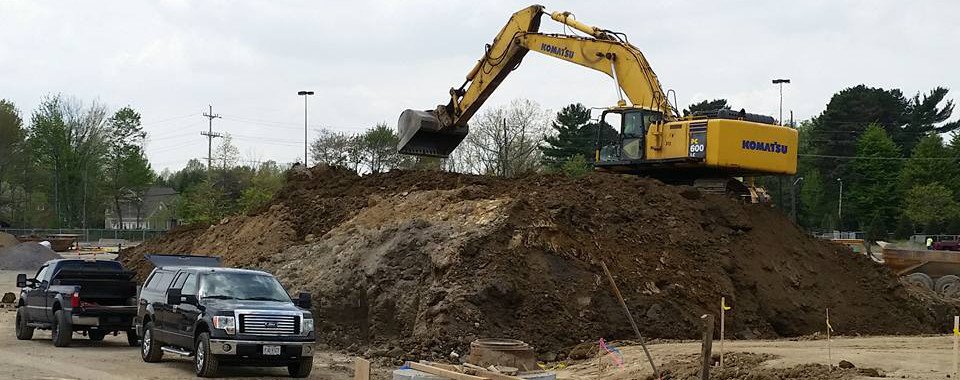
Construction Staking and Layout - For the construction of roads, buildings, structures, pipelines, drainage, etc. These surveys offer construction staking services to coordinate general improvement plans. This is the portion of the surveying that links the design phase to the construction phase of a project.
Lake Erie Submerged Land Lease - A Submerged Land Lease is the mechanism by which Ohio authorizes use of the Lake Erie Public Trust. Leasing submerged land enables the state to manage the Public Trust, accommodate various private and public uses, and help protect the rights of littoral property owners. The professional survey will locate the submerged land to be leased and prepare a metes and bounds description.